

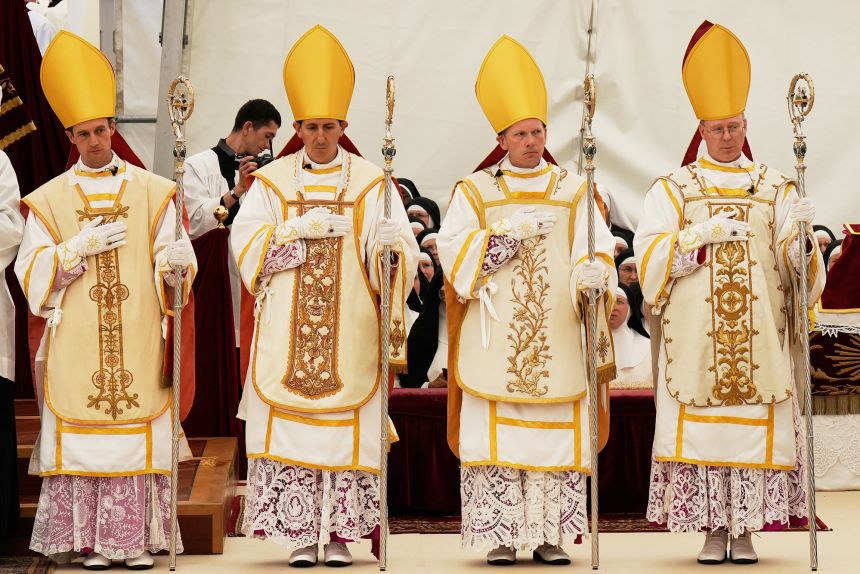

In a decisive move from Rome, the Vatican’s doctrinal office has published a sweeping decree of excommunication against the ultra-traditionalist Society of Saint Pius X (SSPX), and its adherents, following episcopal ordinations carried out without papal approval on Wednesday. This dramatic escalation marks a significant tightening of the Church’s stance against a group that has long challenged its authority.
The decree, issued on Thursday, confirms the immediate excommunication of the four newly ordained bishops, as well as the two bishops who presided over the controversial ceremony. Excommunication, the gravest penalty in the Catholic Church, effectively excludes individuals from receiving the sacraments. However, the ruling extends far beyond these six individuals, encompassing priests belonging to the SSPX and lay members who “formally adhere” to the group, declaring them also in schism and excommunicated. A stern warning has been issued to all “clerics and the lay faithful” to avoid formally following the society, lest they automatically incur the same penalty.
The ordinations proceeded despite fervent appeals from Pope Leo to reverse the decision. His Holiness had, in a final plea on Monday, underscored that such ordinations would constitute a “schismatic” act and a “sin of extreme gravity.” While Pope Leo has yet to comment publicly since the ceremonies, Cardinal Pietro Parolin, the Vatican’s secretary of state, expressed “deep sorrow,” lamenting that the ordinations “break the unity of the Church and incur very specific sanctions – fundamentally, excommunication.”
Historical Rift and Escalating Sanctions
The Society of Saint Pius X, often referred to as the SSPX, was founded in 1970 in Switzerland by Archbishop Marcel Lefebvre, a French prelate. The group quickly found itself at odds with the mainstream Church, officially being suppressed by the Bishop of Fribourg just five years later. A pivotal moment in its history occurred in 1988 when the SSPX ordained four bishops without papal approval, an act that similarly led to their excommunication at the time.
However, the latest action from the Vatican represents a far more extensive clampdown than the 1988 sanctions, which were primarily limited to the involved bishops. Notably, while Pope Francis had previously granted the SSPX permission to administer the sacraments of marriage and confession, the new Vatican ruling declares any marriage or confession offered by the group to be “invalid.” This renders a fundamental aspect of their pastoral activities null and void in the eyes of the Church, a significant increase in punitive measures.
The Heart of the Schism: Doctrinal Disagreements
At the core of the SSPX’s enduring splintering from the mainstream Church lies its staunch opposition to the profound reforms introduced in the 1960s by the Second Vatican Council. The “Lefebvrists,” as they are sometimes known, reject what the council taught on several key theological and pastoral fronts, including religious freedom, ecumenism (which concerns relations with other Christian denominations and religions), and reforms to Catholic worship. This includes their refusal to accept changes such as celebrating Mass in languages other than Latin. It is also important to note that one of the major reforms at the council was a clear condemnation of all forms of antisemitism.
Pope Leo XIV has consistently prioritized church unity throughout his pontificate, emphasizing the crucial link between the pope and bishop as a foundational element of this unity. Addressing journalists on June 16, he acknowledged that the Lefebvrists “refuse to accept certain fundamental elements of the Church, beginning with several points of the Second Vatican Council.” He added, regarding the planned ordinations, “If that is the choice they make, I am sorry, but we must move forward.”
Global Presence and a Path to Reconciliation
Despite its contentious relationship with Rome, the SSPX maintains a significant and active presence globally, particularly in the United States, where it operates a headquarters in Missouri and a seminary for training priests in Dillwyn, Virginia. Father Michael Goldade, one of the bishops newly ordained on Wednesday, leads this very seminary.
In a gesture of pastoral care, the explanatory note accompanying the decree also holds out a welcoming hand: “The Church, as a caring mother, will welcome with sincere affection and active care all those who wish to return to full communion.” This statement leaves open a pathway for reconciliation for individuals within the SSPX who might choose to re-establish their full communion with the wider Catholic Church. For a broader perspective on global religious affairs, readers can explore international news coverage ↗.




Leave a comment